Friday, November 4, 2016

Where have we been? Peru, South America


Where have we been?  Peru, South America. 


We took some time out of our exciting travels around the USA and visited Peru.  Peru is a third world country and as such was a real eye opener!   It has taken me a while to edit the over 3000 photos I took so there will be several chapters for Peru.


So, we flew out of Miami for Lima, Peru at 4:03 in the afternoon and arrived late the same evening.  Once through customs and the usual wait for luggage we met some of our other tour group members.  By now it is totally dark outside as we are shuttled into a bus and taken to our hotel. 

We had an early morning departure from Lima, by bus, along the Pan-American Highway to Pisco, Peru.


We passed through some beautiful scenery along the Pacific as shown above.  We also passed through several rural communities.  As I said earlier Peru is a third world country; given that, the lifestyle of the majority of the population is poor.  Many of the citizens have migrated down from the Andes Mountains to find a better life in the various cities.  No one in Peru is on any kind of government subsidies.  They do what they need to do to build homes, feed and clothe families, and basically survive.  Here are a few photos of homes along the bus route on the Pan-Am.
"Tuk-Tuks" in Pisco (little three wheel cabs)  To us: Taxicabs, cabbies and traffic!


These types of homes are visible throughout Peru. They are called ‘squatters’, but this is not a negative term in Peru as it is here in the states.  Instead, it represents the willingness of all the people to work hard, earn a living and better their positions as they go.  We’ll talk more about the wonderful people of Peru in all the chapters as I show you their beautiful country.

Once we arrived in Pisco we enjoyed a ‘Flight Over the Nazca Lines’.  If you have never heard of them, they are mysterious lines drawn on the mountain top rocks and can only be seen from the air.  The drawings are huge and are known as geoglyphs – drawings on the ground made by removing rocks and earth to create a “negative” image. The rocks which cover the desert have oxidized and weathered to a deep rust color, and when the top 12-15 inches of rock is removed, a light-colored, high contrasting sand is exposed. Because there’s so little rain, wind and erosion, the exposed designs have stayed largely intact for 500 to 2000 years.

Scientists believe that the majority of lines were made by the Nazca people who flourished from around A.D. 1 to 700. Certain areas of the pampa look like a well-used chalk board, with lines overlapping other lines, and designs cut through with straight lines of both ancient and more modern origin.

Have a look….
The Pilots
(Alcatraz) Heron Bird
(Astronauta) Astronaut
(Trapezoide) Trapezoid


Top L (Arana) Spider Top R ((Mono) Monkey Bottom L (Loro) Parrot Bottom R (Ballena) Whale

Top (Arbol) Tree and Bottom (Mano's) Hands

Top (Colibri) Hummingbird and Bottom Condor
Andes Mountains on the return flight from the Nazca Lines

Landing
The Cessna we flew in to see the lines
The rest of the day was spent at the Paracas National Reserve.  The Reserve was created in 1975 and covers 800,000 acres.  It boarders the Pacific and has beautiful sand beaches as well as rocky formations.  The sand is truly amazing as some is brown, some red, some gray and some is golden in color.  The sweeping vistas are awesome!
The various colors of the sand created stunning views.


Even here there are ancient relics! Top: A piece of driftwood that appears to have eyes, mouth and nose creating a face.  However, on the picture on the bottom right you can see the fossil of a sea shell, which you can see below the right eye on the top picture.  On the bottom left is a fossil of another type of shell.
 
Next we went by boat to tour the Ballestas Islands.  “Paracas” is a synonym for sea, winds and nature.  The Ballestas Islands are off the coast near the Paracas National Reserve and is the home of sea lions, penguins and thousands of birds.  The bird droppings(guano) are actually a consumer product in Peru.  The Islands are left totally alone for the most part.  On a regular schedule of every 7 years the park staff goes onto the islands and collects the guano.  This is processed and sold as fertilizer not only to the locals but also as an export.    We were glad we did not have that job!  Instead we just enjoyed the beautiful views and the amazing wild life.  See for yourself……

Fishing boats in the small town where we boarded our boat to the Islands
 
 
The Ballestas Islands are made up of rock, sand and the Pacific


Pelicans


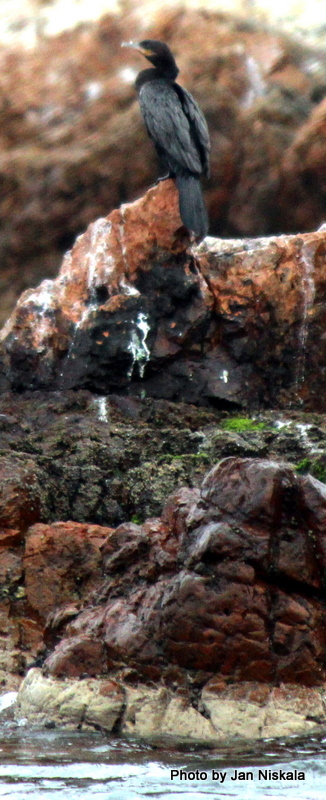
 Cormorants

Blue footed Boobies in flight


'Candelabro', as seen above, which translated means The Candlestick, is an enormous and mysterious geoglyph carved in the sands and measures 55 meters.

This Pelican is so graceful in flight!

Dolphins played in the water


There were many caves and bridges along the shores include this one and others you will see in some pics below.

These little guys are Humboldt Penguins

Peruvian Blue Footed Boobies


Red Headed Vulture

The Islands are literally covered with birds!!

All those black dots on the sand above this cave are birds!!


The fishing boats of Pisco - but obviously the birds love them too!


Pacific treasures

Look close - you can actually see the blue feet of these Boobies

The dog pack!! Actually these are Sea Lions and when they cry out they sound like a wolf-pack.  Isn't the sleeping baby adorable!
This is the sea lion choir!
On the way to our hotel we saw
this parasailer


At the end of the day we stayed in a lovely resort in Paracas.

 
Watch for the next chapter coming soon
Jan 🌷🌷🐾🐾      


Thursday, September 29, 2016

The Jack Daniel Distillery


Who's up for a 'Jack and Coke' ??  We had a great tour through the distillery in Lynchburg Tennessee.  The original distillery which opened in 1866 and is celebrating it's 150th anniversary this year.


As we walked on to the property we commented on how pretty it looked.  From the road no one would even know it was a distillery!


Jack Daniel's is a brand of Tennessee whiskey and the top selling American whiskey in the world. It is produced in Lynchburg, Tennessee, by the Jack Daniel Distillery, which has been owned by the Brown-Forman Corporation since 1956.   I found it interesting that despite being the location of a major operational distillery, Jack Daniel's home county of Moore is a dry county, so the product is not available for consumption at stores or restaurants within the county.(Wikipedia)    Part of the tour though does include tasting the  various flavors of Jack ... yyymmmyy good!!  My favorite was Tennessee Honey, but more on that later ☺
 
Here is the Statue of Jack Daniel in front of the subterranean fresh water spring from whence he once drew the water for producing his whiskey.


I don't know if you can tell in this photo but this is the cleanest spring I've seen in a long time!


The Rickyard is the first stop of the tour. This is where they make charcoal from maple ricks, which is later used for filtering the moonshine. The moonshine is filtered through ten feet of charcoal, which is a way of mellowing the whiskey. Gentleman Jack is actually filtered twice. Once before going into the barrel, which is standard practice. But also once after it has matured in barrels. This time however, only through three feet of charcoal. There’s a panel of tasters and they decide when the charcoal is tired and needs to be replaced. Usually that’s after around six months.


This shows the 'ricks', which are from sugar maples grown in the Tennessee countryside. They are stacked up waiting for their fate.  The burning is actually a technically monitored process  so that the resulting charcoal is not over-burned or under-burned.  The charcoal is used in the mellowing process which we will see in a minute!


Jack Daniel's is made with the water from Cave Hollow Spring which flows at a constant rate of 800 gallons per minute. The temperature is constant at 56 degrees. It is also virtually iron-free.
The whisky is made using corn (80%), rye (12%) and barley (8%). A small amount of sour mash is also used, sourced from an earlier batch.

The whisky is then charcoal mellowed. This process involves dripping the whisky through 10-feet of sugar maple charcoal. Doing this adds significantly to the taste of the drink. It is also what makes Jack Daniel's different. It is not a bourbon whisky but a Tennessee whisky because of this process.  We were not permitted to take photos in the mash and mellowing rooms but here are some 'snaps' we could get.


  There are several buildings on the property that are used to complete the distilling process.  This is where the mash is cooked and then it goes to 'Melllowing'.    


All of the buildings have this gray coloring. It is called  Baudoinia-compniacensis,  a unique whiskey fungus,  found near distilleries. This fungus attaches to warehouses and walkways  at the 147-year-old distillery. This particular type of black fungus is common near distilleries because it uses ethanol as a source of energy for growth. During the whiskey maturation process, at least 2% of whiskey escapes from a barrel as ethanol vapor — perfect for Baudoinia to thrive.   
 
 
The charcoal mellowed whisky is then put into barrels that were made to exacting standards by the Jack Daniel's Distillery itself. It almost takes as much time and effort to make the barrels as it does the whisky.  The barrels are made from white oak. Craftsmen fit the stave's together by hand then toast and char the inside of the barrels. The different char levels create the various flavors of the whisky.  The charring brings out the natural sugar in the wood.  The barrels are  only used once. The used ones are sold, mainly to European distilleries to mature Scottish and Irish whiskies.

Tools of old but some are still used by the Craftsmen today.


The Jack Daniel's Distillery says "age isn't the same thing as maturity". That means, for Jack Daniel's whisky, it is not about how long the bourbon whisky stays in the barrel. It is about the process of getting it there and the experience it has in the barrel.  A calendar is not used at Jack Daniel's to decide   if a whisky is ready for bottling. They do that by tasting it - probably the best job in the world..


Next is the bottling, labeling and tasting!


The Barrel House is where some of the aging barrels of whisky are stored.  But mostly it is where the tasting of the whisky takes place!  We tasted Gentleman Jack, Old No.7, Single Barrel, Tennessee Fire and my favorite Tennessee Honey.  All excellent!!


There are many storage warehouses scattered around the distillery and they are building more all the time.


I vote yes for Jack Daniels from1866 to 2016!


You might have notice that I've been away for awhile.  When you get my next chapter you will see just what we've been up to and where we've been spending our time!

More soon 🌷🌷🐾🐾        
Jan